
Aliens vs. Operational Security: When America's Greatest Secrets Fly Overhead
Before the F-117 Nighthawk was revealed, it was a secret flying through the night. Today's UAP debate may have more in common with that history than most people realize.
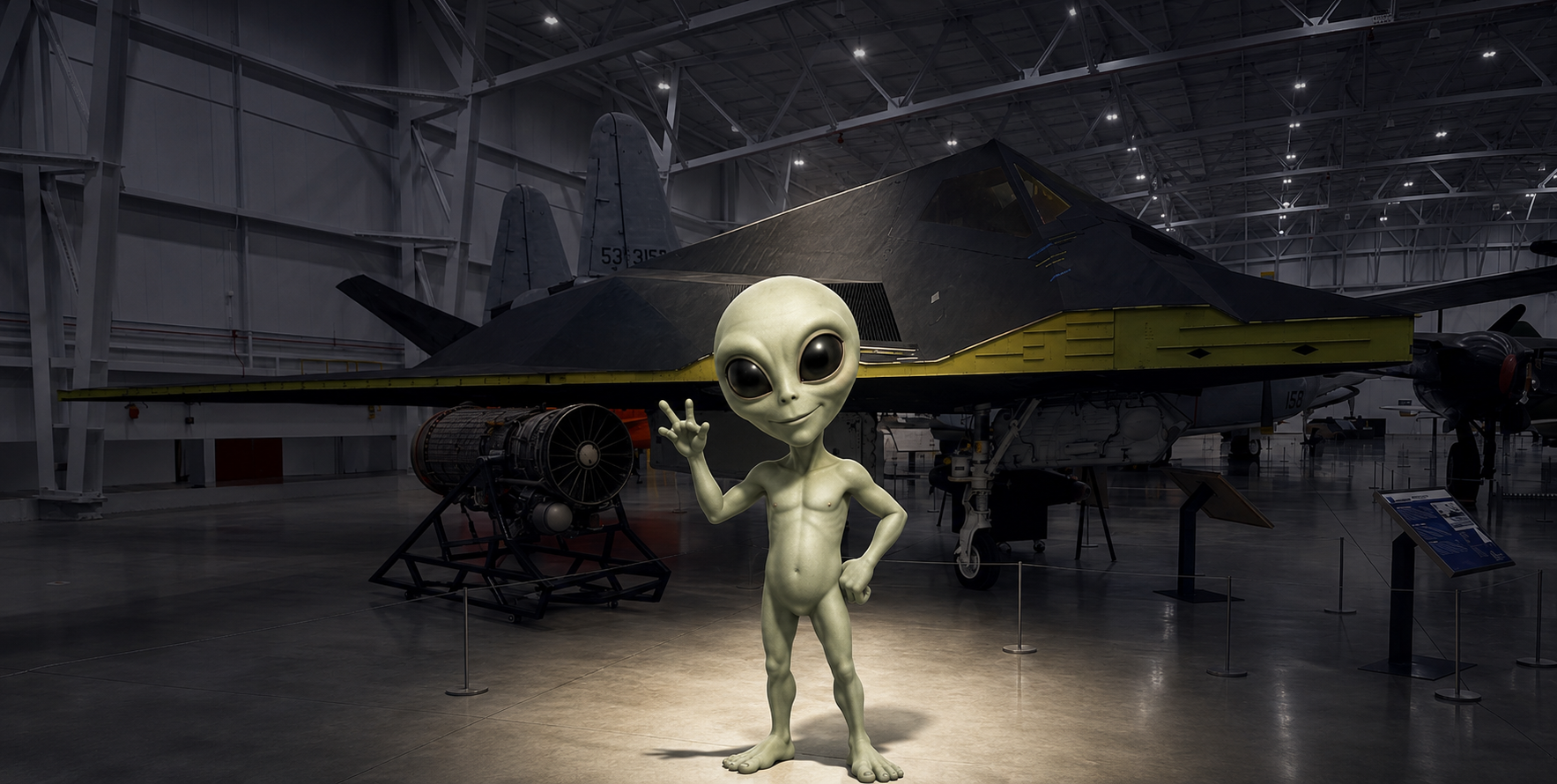
The intersection of UAP speculation and classified aviation history raises questions the F-117 program already answered once before. Illustration: Georgia Dossier.
What if some of the strange objects people see in the sky are not visitors from another world, but technology the government simply is not ready to admit exists?
It has happened before.
Long before the F-117 Nighthawk became one of the most recognizable military aircraft in the world, it was an American secret flying through the night.
The F-117 first flew in 1981 and became operational in 1983. Yet the Air Force did not publicly acknowledge the aircraft until November 1988, when it finally released a grainy photograph of the mysterious stealth aircraft.
There is something almost ironic about that today.
Nearly four decades later, Americans are once again studying grainy military images and videos of unidentified objects, trying to determine exactly what they are looking at.
The Pentagon's All-domain Anomaly Resolution Office, or AARO, released another collection of UAP material on August 7, 2026. Some of that imagery is limited by reduced resolution, blurring and other visual artifacts. Several videos are secondary recordings of infrared displays rather than the original sensor data.
In 1988, the grainy photograph showed an aircraft the government understood perfectly well but was only beginning to reveal to the public.
Today, grainy UAP footage presents a different problem. In some cases, the government itself says there is not enough information to conclusively determine what the object is.
The pictures may look similar.
The circumstances may be very different.
But history gives us a reason to ask questions.
When the Secret Flew at Night
For roughly five years, the United States possessed an operational stealth aircraft while most Americans had no idea what it looked like.
F-117 operations at Nevada's Tonopah Test Range were conducted almost exclusively at night. Darkness helped conceal the aircraft's highly unusual shape.
Still, people knew something was happening.
By the mid-1980s, aviation writers were already speculating about a secret American stealth fighter, often calling it the "F-19." Model companies even sold their imagined versions of the mysterious aircraft.
They were right about one important thing.
There really was a secret airplane.
They were just wrong about what it looked like.
Then the Secret Fell From the Sky
On July 11, 1986, Maj. Ross E. Mulhare was flying an F-117 on a nighttime training mission when the aircraft crashed into a hillside near Bakersfield, California, killing him.
The public still did not know what an F-117 was.
The military restricted the crash site and the airspace above it. Armed sentries kept people away while investigators recovered fragments of the highly classified aircraft.
What happened afterward is perhaps one of the most remarkable parts of the F-117 story.
According to Air & Space Forces Magazine, after the F-117 wreckage had been recovered, crews took wreckage from an old F-101A Voodoo that had been stored at Area 51, broke it apart and scattered the debris around the crash site.
Anyone arriving afterward searching for pieces of America's mysterious new aircraft could instead find pieces of an airplane designed decades earlier.
Think about what that represents.
This was a documented U.S. government crash retrieval involving highly classified technology. The site was secured. Sensitive material was recovered. Access was restricted. Information was tightly controlled. According to the historical account, misleading debris was even placed at the scene to protect the real secret.
It is difficult not to notice the resemblance to allegations that have surrounded the 1947 Roswell incident for decades.
Roswell stories have long included claims of rapid military recovery, secured debris, restricted access and changing explanations about what came down.
There is an important distinction.
The U.S. government has never confirmed that Roswell involved an extraterrestrial spacecraft. The Air Force's official investigation concluded that the material was associated with Project MOGUL, a classified balloon program intended to help detect Soviet nuclear testing.
But the F-117 case demonstrates something important that is not speculation.
When genuinely sensitive American technology crashes, the government is capable of going to extraordinary lengths to retrieve it, control the scene and protect what it knows.
That does not prove the Roswell allegations.
It does prove that secret crash retrieval operations are not merely the stuff of science fiction.
And Then It Happened Again
On October 14, 1987, Maj. Michael C. Stewart was flying another F-117 during a nighttime training mission when his aircraft crashed in the Nevada desert, killing him.
The investigation eventually produced a 322-page report containing 27 sections.
The public received a five-sentence statement.
When reporters pressed the Pentagon for more information, officials offered little more than:
"There is a plane that is missing."
The aircraft's identity remained secret.
Thirteen months later, the government finally acknowledged that the F-117 existed.
UFOs and Secret Aircraft Have Crossed Paths Before
The F-117 was not the first classified American aviation program to create mysteries in the sky.
The CIA has acknowledged that flights involving the secret U-2 and OXCART reconnaissance programs contributed significantly to UFO reports during the 1950s and 1960s.
That point deserves attention.
Some witnesses really were seeing extraordinary aircraft.
They simply did not know what they were seeing.
The government knew considerably more, but revealing the explanation could have exposed some of America's most sensitive intelligence capabilities.
That creates a fascinating problem.
When the government cannot explain something because of operational security, the public naturally begins filling in the blanks.
Sometimes those explanations involve visitors from another planet.
If AI Is Leaping Forward, Why Would Aviation Stand Still?
There is another part of today's UAP debate that deserves consideration.
We are watching artificial intelligence advance at a pace that would have seemed almost unimaginable just a decade ago.
AI (Artificial Intelligence), autonomous systems, computing power, robotics, sensors and advanced materials are all progressing rapidly. Some technologists even debate the possibility of a technological singularity, a point where technological advancement accelerates so quickly that predicting what comes next becomes increasingly difficult.
So why would aviation technology be standing still?
Why would we assume that the aircraft publicly acknowledged today represent the limits of what American aerospace engineers are capable of building?
The F-117 should teach us otherwise.
Imagine seeing one in 1983 without knowing it existed.
Its strange faceted shape would have looked unlike virtually anything else in the sky.
Now move that question forward more than forty years.
Combine artificial intelligence, autonomous flight, advanced materials, new propulsion research, sensor fusion, electronic warfare and enormous computing power with classified defense programs that the public may know nothing about.
What might be flying today?
That does not mean UAPs are secret American aircraft.
It also does not mean they are extraterrestrial.
AARO says it has found no verified evidence of extraterrestrial beings or extraterrestrial technology, and many UAP reports ultimately receive ordinary explanations. Others remain unresolved simply because the available information is insufficient.
But unresolved should not automatically mean alien.
History gives us another possibility.
Forty years ago, someone could have looked into the Nevada night and seen a strange aircraft that officially did not exist.
The witness could not identify it.
The press could not explain it.
The government would not discuss it.
When one crashed, extraordinary measures were taken to protect the secret.
Today, we know what they were protecting.
It was not extraterrestrial.
It was the future.
So perhaps the most interesting question surrounding today's UAP phenomenon is not whether aliens have arrived.
If the F-117 could fly in secrecy for years using the technology of the 1980s, what could be flying tonight in the age of artificial intelligence that the public will not learn about for another five, ten or twenty years?
References
- U.S. Air Force: F-117 Nighthawk first flight, operational history, nighttime operations and November 1988 public acknowledgment. U.S. Air Force, Remembering the F-117 Nighthawk
- Air & Space Forces Magazine: When Secrets Crash, documenting the July 1986 F-117 crash, the reported F-101A debris deception, and the October 1987 crash involving Maj. Michael C. Stewart. Air & Space Forces Magazine, When Secrets Crash
- Central Intelligence Agency: Historical assessment of the U-2 and OXCART programs and their connection to UFO reports. CIA, The CIA's Role in the Study of UFOs
- U.S. Air Force: Official Roswell findings and the government's conclusion regarding Project MOGUL. U.S. Air Force, The Roswell Report
- Department of Defense, All-domain Anomaly Resolution Office: Official UAP imagery, documentation and government assessments regarding unresolved sightings. AARO Official UAP Imagery
Thomas Penn is the writer of this article for Georgia Dossier. © 2026 Georgia Dossier. All rights reserved.