
Rock of the Marne Trains Alongside Marine Corps Black Knights at Fort Stewart
Soldiers from the 3rd Infantry Division and Marines from VMM-264 trained together at Fort Stewart, a quiet moment carrying more than a century of combined history.
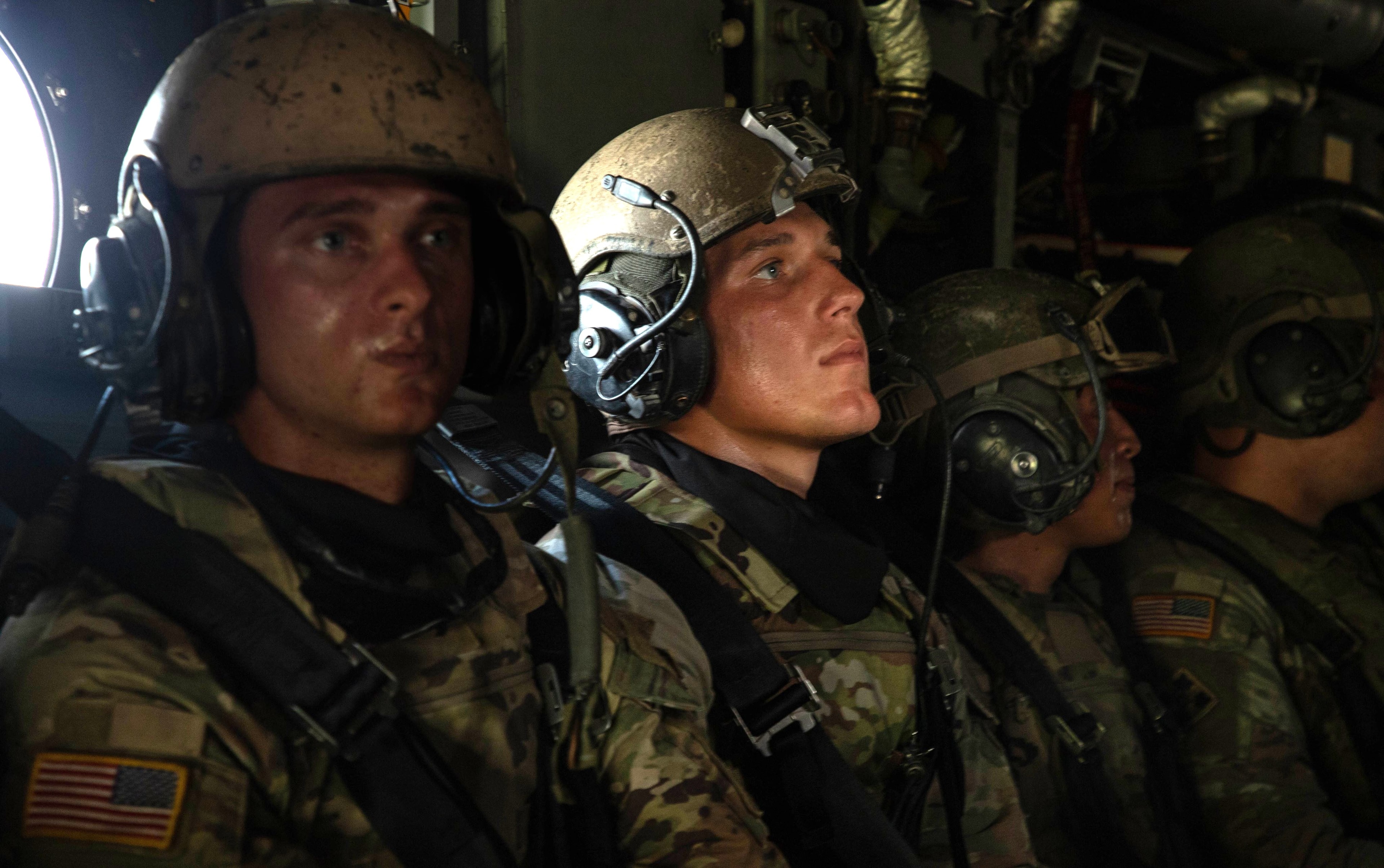
FORT STEWART, Ga. The photograph is a simple one. Soldiers sit close together inside a military aircraft, wearing helmets and communications gear as they wait for the next phase of a training mission.
There are no ceremonial formations or carefully arranged poses. It is the kind of moment that happens thousands of times during military training and is rarely noticed outside the people who experience it.
But there is quite a bit of history represented in this photograph.
The soldiers are members of the U.S. Army's 3rd Infantry Division and were taking part in joint training at Fort Stewart with Marines from Marine Medium Tiltrotor Squadron 264, known as the Black Knights.
On Aug. 5, soldiers from 3rd Battalion, 15th Infantry Regiment, 2nd Armored Brigade Combat Team trained with the Marine squadron on operations that included refueling Army Bradley Fighting Vehicles.
The training was designed to give Army and Marine units experience working together in the field, particularly when it comes to moving supplies and keeping armored forces operating.
It is the kind of work that receives considerably less attention than tanks, aircraft and weapons, but it can determine how long a military force is able to remain in the fight.
The soldiers involved are part of one of the most historic divisions in the United States Army.
The 3rd Infantry Division was organized during World War I and earned its best known nickname during the Second Battle of the Marne in France in 1918.
During a major German offensive, troops of the division held their position along the Marne River as German forces attempted to break through Allied lines and push toward Paris.
The division's stand led to the nickname "Rock of the Marne."
The phrase "Nous resterons là," or "We shall remain here," became closely associated with the division and remains part of its identity more than a century later.
The 3rd Infantry Division went on to serve extensively in World War II, Korea, Iraq and Afghanistan.
There is also a direct historical connection between the soldiers participating in the Fort Stewart exercise and one of America's best known soldiers.
Audie Murphy served with the 15th Infantry Regiment during World War II. Murphy became one of the most decorated American combat soldiers of the war.
The soldiers in this training exercise were from 3rd Battalion, 15th Infantry Regiment.
The battalion is part of a regimental history that reaches back to the 19th century and includes service in China, where the regiment spent many years during the early 20th century. That period helped establish traditions still associated with the regiment today, including its familiar motto, "Can Do."
The Marines training with them also come from a unit with a long history.
Marine Medium Tiltrotor Squadron 264 traces its origins to 1959. Known as the Black Knights, the squadron has supported Marine operations for decades and has served in conflicts including Iraq and Afghanistan.
The squadron later transitioned to the MV-22 Osprey, the tiltrotor aircraft that combines vertical takeoff and landing with the speed and range of a conventional airplane.
VMM-264 was deactivated in 2020 during a broader Marine Corps restructuring effort.
Five years later, the Black Knights returned.
The squadron was reactivated on Dec. 11, 2025, at Marine Corps Air Station New River in North Carolina.
That means the Fort Stewart training occurred less than eight months after the squadron returned to active service.
The combination of the two units makes the exercise noteworthy.
The 3rd Infantry Division has more than a century of combat history behind it. The Black Knights have recently returned to the active Marine Corps and are again preparing for expeditionary operations.
Their work together at Fort Stewart also reflects changes taking place across the military.
In a future conflict, established supply routes may not always be available. Fuel sites, transportation networks and logistics hubs are likely to be among the first targets an enemy attempts to disrupt.
An armored vehicle without fuel does not remain useful for long.
Neither does an aircraft without parts, ammunition or maintenance support.
That is why military units train to use resources across service lines. If Marines can help sustain an Army armored unit, or Army capabilities can support Marines operating somewhere else, commanders have more options when circumstances change.
That is what was taking place at Fort Stewart.
The Army and Marine Corps were not simply demonstrating that they could work beside one another. They were practicing the much more difficult task of making their equipment, personnel and support systems work together under field conditions.
The photograph captures only a few seconds of that training.
Four soldiers are seated inside an aircraft waiting to move.
There is nothing particularly dramatic about the moment, and that may be what makes the image interesting.
The soldiers in the photograph belong to a division whose history reaches back to the battlefields of France in World War I and a regiment whose soldiers fought through some of the hardest campaigns of World War II.
They are now training with a Marine squadron that has returned to service after five years off the active rolls.
The equipment is different. The battlefield has changed. So have the threats.
The basic responsibility has not.
The people in that aircraft are preparing for the possibility that one day the training may no longer be training.
That is ultimately what the photograph shows.
Thomas Penn is the writer of this article for Georgia Dossier. © 2026 Georgia Dossier. All rights reserved. Official U.S. military photographs should be credited to the originating Department of Defense photographer and military organization. Georgia Dossier claims no ownership of official U.S. government imagery.