
USS George Washington Arrives in Middle East as U.S. Carrier Presence Shifts Amid Iran Tensions
The USS George Washington Carrier Strike Group has entered the CENTCOM area of responsibility, replacing the USS Abraham Lincoln as U.S. naval presence in the Middle East holds firm amid elevated Iran tensions.
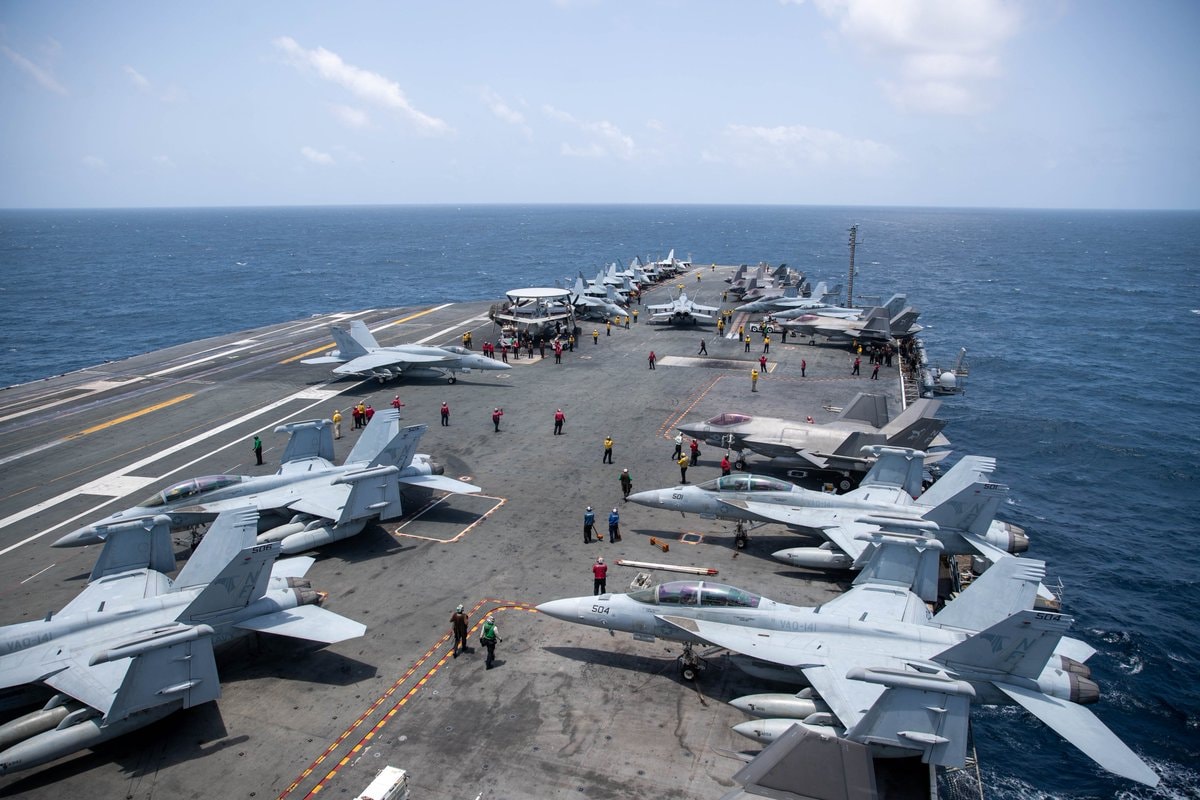
Photo: U.S. Central Command
U.S. Central Command has released a new image of the USS George Washington as the aircraft carrier arrives in the Middle East, marking a significant shift in the U.S. Navy's carrier presence in the region as tensions with Iran remain elevated.
The George Washington Carrier Strike Group entered the CENTCOM area of responsibility on Wednesday, positioning another major American naval force in a region that continues to face heightened military and political uncertainty.
CENTCOM's area of responsibility encompasses 21 nations across the Middle East, Central Asia and South Asia, making it one of the most strategically consequential commands in the U.S. military.
The George Washington is arriving as the USS Abraham Lincoln prepares to transition out of the region, effectively handing over the carrier presence that has provided the United States with significant airpower, surveillance and strike capability during a period of increased concern surrounding Iran.
An American carrier strike group is considerably more than a single ship. It represents a mobile military force built around an aircraft carrier and typically supported by guided missile destroyers, cruisers, submarines, logistics vessels and an embarked carrier air wing capable of conducting operations hundreds of miles from the ship itself.
The arrival of the George Washington therefore represents both continuity and deterrence. While one carrier rotates out, another is moving into position, ensuring that U.S. naval aviation and strike capabilities remain available to commanders in the region.
The deployment comes as Washington continues to monitor Iranian military activity and broader instability throughout the Middle East. Carrier movements do not necessarily signal that military action is imminent, but their presence provides the United States with options that can be exercised rapidly should conditions deteriorate.
For Iran and other regional actors, the message is difficult to miss: even as individual ships rotate home, the American military presence in the region remains very much in place.
Photo: U.S. Central Command